Eggs
Updated: Feb 18
Methods of cookery:
In this module, we are covering multiple egg cookery methods: Poaching, boiling, frying, scrambling, omelets, and emulsification (hollandaise).
Dishes Prepared:
The dishes we’re preparing this week are Eggs Benedict, an American style omelet, Hollandaise sauce, tomato sauce, basil vinaigrette, and an eggplant stack.
Lab Learning Objectives:
Demonstrate the proper techniques for cooking eggs in various styles, including poaching and making an American-style omelet, while understanding the nuances of texture, flavor, and presentation.
Prepare a classic hollandaise sauce with precision, applying the correct emulsification techniques to achieve a smooth, velvety consistency and understanding its applications in egg-based dishes like Eggs Benedict.
Produce a flavorful tomato sauce from scratch, mastering the steps of simmering and seasoning to create a versatile, well-balanced sauce suitable for a variety of culinary preparations.
Prior Knowledge:
Before/outside of this class, I have basic experience cooking eggs at home, mostly scrambled, fried, or boiled. I understand that eggs change texture when heated, but I do not fully understand why that happens scientifically or on a molecular level yet. I also have never made hollandaise sauce from scratch, and have never poached an egg.
Background Information:
Research and discussion of the method of cooking/ techniques:
Boiling: Boiling eggs involves cooking them in water at specific temperatures. Fully boiling water can cause rubbery whites and overcooked yolks. For best results, eggs are supposed to be cooked at a gentle simmer around 180 F for hard boiled eggs. Overheating causes too much protein coagulation, which gives the eggs a tough texture and a grey discoloration on yolks. This is something I’ve personally experienced when boiling my eggs for the week (easy protein), and had I known it was something as simple as an iron sulfur reaction, I may not have flipped out and tossed eight perfectly good eggs.
Poaching:
Poaching involves cooking eggs gently in water at 170-180F. The egg is cracked into simmering water and cooked until the white sets but the yolk remains soft. Adding a small amount of vinegar to the water can also help the proteins coagulate better.
Frying:
Fried eggs are cooked in fat at around 250F. Lower heat makes tender whites, while higher heat makes crispy edges. Because frying applies direct heat from below, it increases the risk of overcooking if the heat is not controlled.
Scrambling:
Scrambled eggs require slow, gentle heat. Lots of stirring creates small and creamy curds, while less stirring forms larger curds. Overheating causes water to separate from the proteins, resulting in a rubbery texture.
Omelet:
An American omelet is thicker and more browned compared to a French omelet. It is cooked over medium heat, allowed to set before folding, and usually filled with cheese, vegetables, or meats. Browning occurs due to Maillard reactions on the surface, making a deeper flavor.
Hollandaise (emulsification):
Hollandaise is one of the five “mother” sauces of French cuisine. It’s made by emulsifying egg yolks and clarified butter with lemon juice and vinegar. It requires gentle heat and constant whisking. Egg yolks act as emulsifiers. If overheated, the proteins over coagulate and the sauce breaks and turns into scrambled eggs. It a super tricky sauce to make without breaking.
Tomato Sauce/Mother Sauce (Simmering):
Tomato sauce is made by slowly simmering tomatoes with aromatics (such as onions, garlic, and basil). Simmering allows flavors to concentrate without burning. Proper seasoning balances acidity with sweetness and salt.
Scientific Principles:
Eggs contain proteins suspended in water. When heated, the proteins unfold/denature, they can coagulate, and form a protein network. The liquid turns into a soft solid, and overcooking causes a rubbery texture
Research and discussion of primary ingredient ;
Eggs have been used and eaten for thousands of years and are produced globally. Chicken eggs are the most common eggs used in the culinary arts. They’re used for stabilizing in baking, thickening/coagulation, foam in foods like meringue, and they bind ingredients.
Sensory characteristics of eggs:
Appearance: Raw eggs are transparent (the white) and yellow/orange (yolk). When they are cooked, they become opaque due to protein coagulation.
Texture:The texture can range from liquid to custard-like to firm depending on temperature and if they're cooked.
Flavor:The flavor of the egg is described as mild and slightly savory. Overcooked eggs can taste like sulfur.
Aroma:Eggs smell mild when fresh. The sulfur aroma increases with overcooking.
Dish/method variations:
Boiled eggs can be cooked a few different ways depending on the texture you want. A soft boiled egg has a runny yolk and a gently set white. A medium boiled egg has a slightly firmer yolk but is still a little creamy in the center. A hard boiled egg is fully set all the way through.
Poached eggs also have different methods. The traditional shallow poach cooks the egg in simmering water. The whirlpool method involves stirring the water first so the egg white wraps around itself. The strained egg method removes the looser and more watery whites before poaching to help the egg hold its shape. Some restaurants will adjust vinegar and salt in the water to help the egg set neatly and look more polished/appealing in presentation.
Hollandaise sauce also has variations. Béarnaise adds tarragon and shallots for more flavor. Mousseline is hollandaise that’s been “lightened” with whipped cream to make it airy and smoother.
Recipes:
Eggs Benedict:
Ingredient: | Amount: |
English Muffin | 2 ea |
Canadian Bacon slices | 4 ea |
Eggs | 4 ea |
White vinegar | 2 oz |
Hollandaise Sauce | 4-8 oz |
Salt | TT |
Omelet:
Ingredient: | Amount: |
Shallot (small dice) | 1 tbsp |
Clarified butter | 1 oz |
Eggs | 3 ea |
Salt and pepper | TT |
Fresh herbs | 2 tsp |
Eggplant Stack:
Ingredient: | Amount: |
Eggplant | 1 ea |
Tomato sauce | 8 oz |
Flour | 2 oz |
Kosher salt | TT |
White pepper | 1 tsp |
Eggs | 2 ea |
Breadcrumbs | 2 oz |
Vegetable oil | As needed |
Ricotta | 2 oz |
Mozzarella | 4 oz/ 8 slices |
Parmesan | 2 oz |
Basil sprigs | 4-6 ea |
Basil oil | As needed |
Basil Vinaigrette
Ingredients | Amount: |
Blanched Basil Puree | 2 fl |
Rice Vinegar | 1 fl |
Apple Cider Vinegar | 1 fl |
Oil Blend | 4 fl |
Lemon, zested & juiced | 1 ea |
Honey | 1 fl |
Salt | Pinch |
Plan of Work:
Time | Task | Time taken |
8:00 | Chef huddle | 30 min |
8:30 | Collect ingredients | 15 min |
8:45 | Begin mise en place | 30 min |
9:15 | Begin preparing eggplant (breading) and tomato sauce | 30 min |
9:45 | Cook bacon/ toast muffin | 15 min |
10:00 | Fry eggplant and finish tomato sauce | 30 min |
10:30 | Make omelet and poach eggs | 30 min |
10:45 | Begin assembling and plating | 15 min |
11:00 | Plates up, eat | 15 min |
11:20 | Begin final cleaning jobs | 40 min |
Works Cited:
Culinary Institute of America. (2011). The professional chef (9th ed.).
Gisslen, W. (2018). Professional cooking (9th ed.). Wiley.
Lopez-Alt, J. K. (2015). The food lab: Better home cooking through science. W. W. Norton & Company.
McGee, H. (2004). On food and cooking: The science and lore of the kitchen.
Ruhlman, M. (2007). The elements of cooking: Translating the chef’s craft for every kitchen. Scribner.
Results
Overall, the techniques practiced in this lab were successful, with a few challenges that kind of turned into learning opportunities. We prepared Eggs Benedict, hollandaise sauce, tomato sauce, basil vinaigrette, and an eggplant stack. Most cooking methods worked as intended. The most challenging dish/technique was the hollandaise sauce.Poaching worked well on the second attempt. In the first attempt, my partner used the whirlpool method we saw in class. Unfortunately the egg whites scattered all over the pot due to the aggressive movement of the whirlpool. On the second attempt, I used a method that Chef Plana showed us in a demo. The method wasn't much different, but we didn’t create a whirlpool. It was successful. The white set properly while the yolk remained soft. The tomato sauce developed a great flavor while simmering, and we had no issues with it. The hollandaise nearly broke due to excessive direct heat. However, with guidance from Chef Dan and Chef Souji, we managed to save the sauce and it turned out great. I could literally see the point of no return for the hollandaise just ten seconds down the line had Chef Dan not stepped in and helped me. With some temperature adjustment, it was saved and restored to a smooth consistency. This really reinforced how delicate the Hollandaise is for me, and how precise heat control must be. The eggplant stack turned out well minus a few gaps in the breading. Using the fryer gave the outside breading a nice crispy texture, and as the tomato sauce worked out, it turned out great.
Sensory Results:
Eggs Benedict:
Taste: Super rich, but I will say the acidity from the hollandaise and vinegar in the poached egg cut through the richness of the yolk and bacon.
Flavor: Savory, tangy, bright. The Hollandaise had a much more aggressive flavor than I thought it would, but it was good. I also loved the hearty egg yolk.
Texture: Soft poached egg with a runny yolk, smooth hollandaise, and crispy English muffin base. The bacon was a little weird, almost rubbery or squishy, but it tasted good.
Appearance: The plating could've been a little neater- we could’ve propped the top half of the muffin up against the rest of the sandwich, but we just put it right on top. It kind of just looked like an overflowing sandwich. The poached egg held its shape, and I trimmed off some of the imperfections in the whites. The hollandaise had a smooth, glossy finish.

Eggplant stack:
Taste: Balanced acidity from tomato sauce with the melted mozzarella.
Flavor: Earthy eggplant paired great with the bright basil and tomato sauce. It was savory but not too rich which was nice.
Texture: Crisp exterior from frying, soft interior, layered with different textures from the cheese and sauce.
Appearance: Unfortunately our stack looked like the Leaning Tower of Pisa. We could’ve taken a little more time while assembling it, but we were short on time and did the best we could. I also would’ve loved it if we'd topped it with melted mozzarella, but it still looked relatively ok. The basil leaf garnish with the basic oil on the plate was a nice touch and I think it saved the overall look.

Evaluation of results
Successfully cooking eggs depends on protein denaturation and coagulation. According to McGee (2004), egg proteins begin to coagulate at pretty low temperatures, which would explain why temperature control is so important. The poached eggs worked because the simmering temperature stayed low and controlled, just below a boil.
The Hollandaise nearly failed because emulsified sauces need a stable temperature and constant whisking. When overheated, proteins can overcoagulate and “force out” the liquid in the eggs, causing the sauce to break (Gisslen, 2018). Reducing the heat stabilized the sauce and the constant whisking and addition of clarified butter also helped to save it.
Frying the eggplant worked well because the oil temperature was high enough to make a crispy crust through dehydration and browning, while preventing too much oil absorption. I was pleasantly surprised at how the fried eggplant wasn’t greasy or anything.
Techniques that worked well:
Poaching (the second time around): Proper temperature control, and the white remained intact once I decided to forgo the whirlpool. I also am sure the addition of vinegar to the water helped a bunch.
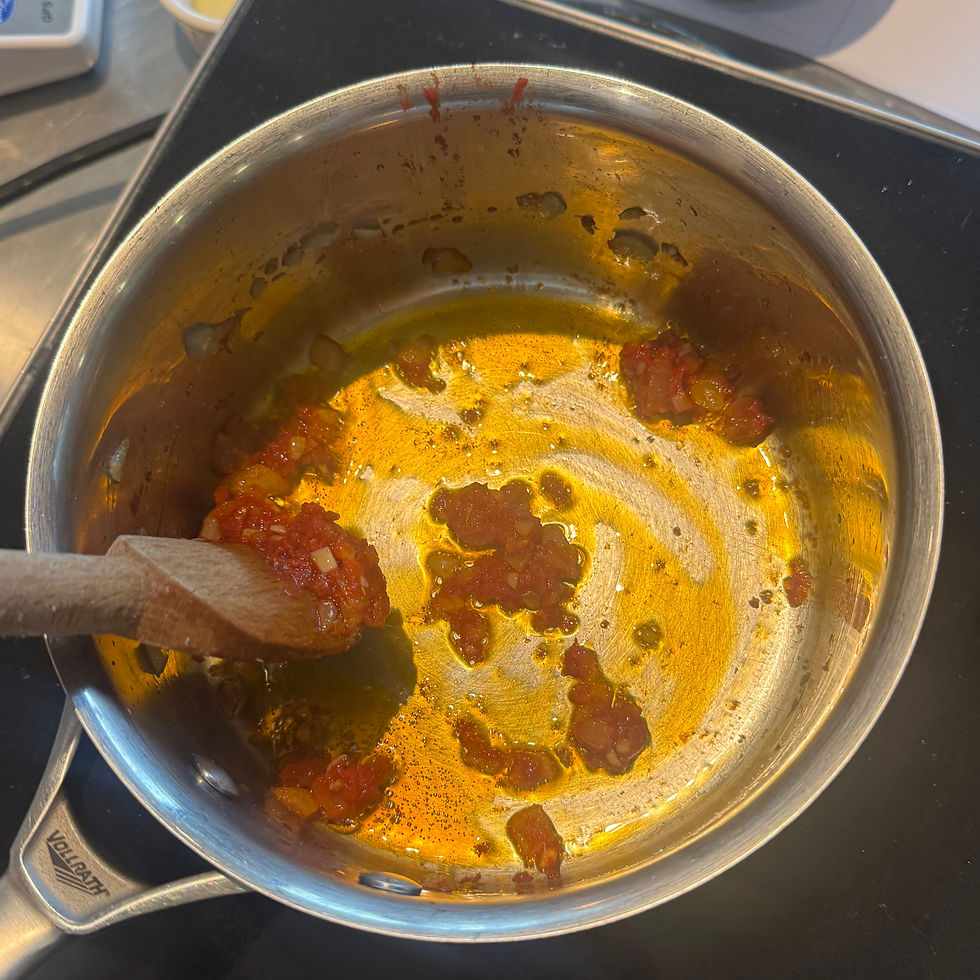
Simmering tomato sauce: Slowly simmering the sauce was a total success. I think I’m still a little upset about our failed tomato soup from the second week, so I was super eager to take the lead on making the tomato sauce. I was sure to simmer the sauce and thoroughly cook the tomato paste, especially after the disastrous taste and flavor of our tomato soup. I was determined not to let it happen again, and the sauce turned out perfect and delicious. The addition of the basil leaves added a bright and pleasant flavor. I also really enjoyed using the immersion blender.
Techniques that need improvement:
Hollandaise (initially): Too much direct heat caused the sauce to coagulate far too quickly, and it began to break. That sauce was literally seconds from being unsalvageable. The addition of clarified butter, quicker whisking, and the removal of direct heat saved it. Chef Souji showed me the problem: the water level in the pot I was using to heat the bottom of the bowl was too high. The boiling water itself should not be directly touching the bottom of the bowl in which the sauce is being cooked. I believe that direct contact is what nearly messed me up.
Breading: I was primarily working on the tomato sauce when the eggplant was being breaded, so I’m unsure what exactly caused the slight “chipping” in the breading. I think that maybe there was too much moisture on the eggplant, or maybe it wasn't completely submerged in the eggs. It also could’ve been moved around too much in the fryer. Either way, the egg plant was missing a few patches of breading upon removal from the fryer, but it was nothing drastic.
Improvements to implement:
The primary thing I think we need to work on, is temperature control when it comes to emulsifications with eggs. The fettucini carbonara we made in another lab also broke due to too much direct heat, so it’s disappointing that we made the same mistake again. That being said, I’m confident now. I feel like I’ve learned a lot about temperature control, and feel that I now have the proper tools and knowledge to prevent it from happening a third time. I plan on reducing the amount of direct heat when making these sauces, and being more mindful overall when observing the temperature. More vigorous mixing could aslo help.
Something else I would love to work on is plating. I think that our plating has been pretty weak thus far, and I’d really love to take a little more time and be more meticulous. I think something specific we could change to improve on this, is just making sure we aren’t falling behind on our plan of work timeline. Typically when we assemble our plates, we are racing against the clock, and are simply trying to get all our food on the plate. I would love to be able to allow more time for us to be more intentional about arrangements and garnishes in the future.
Conclusions
Overall, this lab was a really solid learning experience. I was able to practice several different egg cooking methods, including poaching and making hollandaise, and I saw (again) how small temperature changes can completely affect the result. Making hollandaise sauce was definitely the most challenging part for me, but I’m grateful for Chef Dan and Chef Souji’s heroics that saved it. Almost breaking the sauce caused me to panic and forced me to really understand how delicate coagulation is.
I also feel like I have a better understanding of how simmering builds flavor and prevents bitterness in something like tomato sauce and how proper breading and frying techniques affect texture in the eggplant stack. Even though I had cooked eggs before at home, I never took the time to try and understood the science. I feel like the knowledge I have about it now will be applicable to other areas of cooking.
Beyond the main objectives, the importance of patience and temperature control were definitely driven home to me. I also learned that mistakes aren’t failures if you can fix them and understand why they happened, as I did with the Hollandaise. These skills will definitely apply in future labs.
I still need more practice with hollandaise and other egg based sauces, and working quickly while maintaining the proper temperature. Overall I feel much more confident cooking eggs with different methods.
Works Cited:
Culinary Institute of America. (2011). The professional chef (9th ed.).
Gisslen, W. (2018). Professional cooking (9th ed.). Wiley.
Lopez-Alt, J. K. (2015). The food lab: Better home cooking through science. W. W. Norton & Company.
McGee, H. (2004). On food and cooking: The science and lore of the kitchen.
Ruhlman, M. (2007). The elements of cooking: Translating the chef’s craft for every kitchen. Scribner.

Comments